We are pleased to announce the winners of the EISA Postdoctoral Bridge Grant scheme:
-
- Sara Kermanian
- Camilo Eduardo Espinosa Díaz
- Anne Lene Stein
- Laila Zulkaphil
- Sachiho Funabashi
- Eric Repetto
EISA Postdoctoral Bridge Grants support recently graduated or final-year PhD students who have not secured an academic contract or fellowship. They are designed to help bridge the gap between a doctorate and a postdoctoral funded/salaried position.
The recipients will utilise the EISA funding to work on the following objectives:

Sara Kermanian
University of Sussex
The EISA Postdoctoral Bridge Grant supports the development of my doctoral research into a programme of publications and future research. My PhD thesis, Time as Possibility, Scale as Power: Entanglement and the Emergence of International Imaginaries of Democratic Confederalism and Neo-Ottomanism in the Kurdish–Turkish Conflict, argues that interpretations of non-Western world-ordering projects remain shaped by a persistent West–Rest dualism. It shows how this “dualist imaginary” extends across mainstream, critical, and post/decolonial International Relations through deeper ontological and epistemological assumptions about the roles of imaginaries, time, and spatial scale, obscuring the relational production of international imaginaries, political agency, and responsibility. In response, through a critical engagement with Cornelius Castoriadis, Karen Barad, and international historical sociology, the thesis develops self-comparison as a non-Eurocentric methodology explaining how international imaginaries emerge through relational, multi-trajectory processes of spatio-temporal self-assessment. It also introduces time as possibility and scale as power as self-comparison’s central analytical tools. The resulting framework interprets non-Western world-ordering projects neither against a universal model nor through relativist self-reference, but through actors’ assessments of their uneven political possibilities and its in/justice.
The bridge grant enables me to pursue three interlinked projects. First, I will prepare a standalone article that introduces self-comparison to a broad IR audience, putting it in dialogue with non-Western, post-Western and Global IR and showing how it can enhance these approaches by addressing the unexamined problems of the dualist imaginary. Second, I will develop a book proposal based on the thesis, making the adjustments needed to prepare it for a wider transdisciplinary audience. Third, I will prepare a major funding application that extends my critique of dualist imaginaries to debates about a “post–rules-based” international order, focusing on the tension between resurgent US imperialism under President Trump and the Islamic Republic of Iran’s hegemonic and imperialising imaginaries and tendencies.
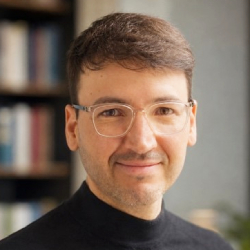
Camilo Eduardo Espinosa Díaz
Autonomous University of Madrid
This project aims to transform the doctoral dissertation “Technologies of Power: Infrastructure, Services and Actors in the Colombian War” into an academic monograph proposal for a leading international publisher. The research offers a relational, material, and situated analysis of the Colombian war, showing how civil infrastructure, social services, and everyday practices of different actors produce authority, political order, and forms of state-building in historically marginalised territories.
Based on a dissertation composed of articles, the project examines both state and non-state actors, including the Colombian Army, the FARC-EP, Black communities in the Colombian Caribbean, and the Catholic Church. It argues that state-building in wartime cannot be understood solely through formal institutions or the monopoly of violence. Rather, it is also configured through infrastructure, social services, community practices, and situated forms of authority that contest, assemble, and reconfigure political order.
The requested funding would allow me to devote a specific period of work to the intellectual and editorial restructuring required to turn the dissertation into a monograph with a theoretical contribution and broader accessibility for both academic and non-specialist audiences. Part of the funding would also support my participation in EISA-PEC 2026 in Lisbon, Portugal, which would contribute to my professional development by allowing me to engage with international scholarly debates and expand my academic network.

Anne Lene Stein
Lund university
This project develops my PhD dissertation, Agonism against the odds: Epistemic disruptions and bodies of dissent in Palestine and Israel, into a single-authored monograph. Defended at Lund University in June 2025, the dissertation examines how performative protest challenges epistemic violence and reconfigures antagonistic political relations in one of the world’s most asymmetrical and polarised conflict contexts.
Drawing on multi-sited ethnographic fieldwork across Jerusalem, Tel Aviv, Ramallah, and Haifa, the project develops the concept of agonistic epistemic disruptions to theorise how embodied dissent intervenes in dominant knowledge regimes and opens space for alternative political imaginaries. It contributes to agonistic political theory by situating it within conditions of structural asymmetry and protracted violence, while also offering new empirical insight into Palestinian and Israeli activist practices. Methodologically, it advances a reflexive agonistic ethnographic approach attentive to the politics of knowledge production, positionality, and the tensions of researching dissent under conditions of inequality.
The monograph speaks to political theory, peace and conflict studies, anthropology, and Middle East politics. It intervenes in timely debates on epistemic violence, dissent, political agency, and democratic possibility under protracted conflict. At a moment when activist practices in Palestine/Israel are highly visible yet often misrepresented, the book offers a nuanced and empirically grounded account of how embodied protest reshapes political imagination.
The EISA Postdoctoral Bridge Grant provides dedicated writing time to develop the dissertation into a coherent and competitive monograph project. During the grant period, I am refining the manuscript’s overall argument and structure, preparing a full book proposal, rewriting the introduction for an interdisciplinary readership, and revising one empirical chapter into a sample chapter for submission to academic publishers. This work supports my transition from doctoral research to independent scholarship by consolidating the project’s theoretical contribution and positioning it within wider debates on dissent, epistemic violence, political agency, and democratic possibility under conditions of protracted conflict.

Laila Zulkaphil
University of Manchester
The humanitarian aid sector is simultaneously facing rising needs fueled by violent conflicts and the climate crisis, alongside shrinking budgets as major donor governments cut foreign aid. As a result, humanitarian actors are experimenting with innovative, market‑based financing mechanisms. My doctoral research examined one such instrument: humanitarian impact bonds, in which private investors provide upfront capital to implementing organizations and are repaid by outcome funders, with interest, if predefined results are achieved. The EISA Bridge Grant will allow me to prepare, publish, and disseminate an article based on my PhD research, which argues that fascination with novelty for its own sake was a key driver behind the adoption of impact bonds in the humanitarian sector, sometimes resulting in a misfit between the tool and the problems it was intended to solve. With several other articles already under consideration at various journals, this latest piece will enable me to complete the dissemination of my doctoral research and build a strong publication record.
Additionally, the grant will give me the focused time needed to apply for postdoctoral fellowships. My PhD found that setting up new financing mechanisms are often so complex and resource‑intensive that they remain largely the preserve of well‑resourced international agencies headquartered in the Global North. This creates a troubling paradox: despite the sector’s commitment to localization, local responders – those closest to the affected communities and best positioned to deliver contextually-grounded and cost-effective aid – risk being excluded from emerging financing models. Therefore, my postdoctoral project will ask: whose power do these mechanisms serve, and how do local responders experience them? Applying a decolonial lens, I will interrogate how innovative humanitarian finance potentially reproduces colonial power asymmetries within the humanitarian system and explore how it could be reimagined by centering the roles, perspectives, and knowledges of local responders.

Sachiho Funabashi
SOAS
I am honoured to be one of the recipients of the EISA Postdoctoral Bridge Grant, which will support two of my postdoctoral projects centred on the concept of peace.
The first project is to submit a peer-reviewed article based on my PhD thesis. My thesis explores the meanings of peace in the UK and Japan’s foreign policy discourse on their intervention in Afghanistan from 2001 to 2010. It argues that the concept of peace derives its meaning primarily from state identity, which is constructed from the state’s understanding of its historical experience of war and peace, as well as from its positive and negative associations with external actors. This differs from security-oriented research, which tends to posit that security informs the content of identity, which is constituted through the binary separation of Self and Other. Instead, my thesis provides an alternative understanding of the relationship between the concept (peace) and identity, and of how they are constructed.
My second project is to apply for a postdoctoral fellowship. The proposed project builds on my PhD research and examines how peace intersects with pacifism and militarism in Japan and Estonia, drawing on both government and public discourse. Grounded in a critical and relational approach, this investigation examines the embeddedness of peace within the imperial and colonial legacies of militarism. It aims to make conceptual, theoretical, and empirical contributions to the broader field of IR and to offer insights into thecurrent political landscape, where critical, relational, and conceptual intervention in debates on war and peace is most needed.
EISA Postdoctoral Bridge Grants will allow me to dedicate myself to the two tasks I detailed above: submitting the journal article and applying for the fellowship. These outputs will strengthen my publication record and better position me for the postdoctoral fellowship.
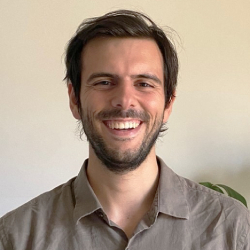
Eric Repetto
Sciences Po Paris
I intend to use the EISA Postodoctoral Bridge Grant to work on three upcoming publications, and to prepare my project proposal for future postdoctoral applications. I am currently working on a co-authored piece on the digital turn in economic statecraft, one on the (missing) link between digital sovereignty and violence, and a single-author piece on the alternative evolutions of the sovereignty-market nexus in the digital age between the EU and the US.
As for the postdoctoral project, I intend to develop and propose a project that investigates the “manufacturing of scarcity” of access to AI and quantum technologies. My goal is to investigate how the global diffusion of AI and quantum is being shaped by policies limiting their availability both at the inter- and intra-state level (i.e., shaping who gets access to technologies and under what conditions both among states, and within domestic societies), how these policies and the imaginaries and coalitions producing them interact, and what transnational hierarchies of power they effect. This proposal overcomes an existing divide across literatures on the governance of technology diffusion, split between state- and security-driven explanations at the international level, and societal and economic interpretations at the domestic level. Ultimately, I want instead to work towards developing a new, more integrated framework on the “manufacturing of scarcity” of dual-use technology availability, both internationally and transnationally.