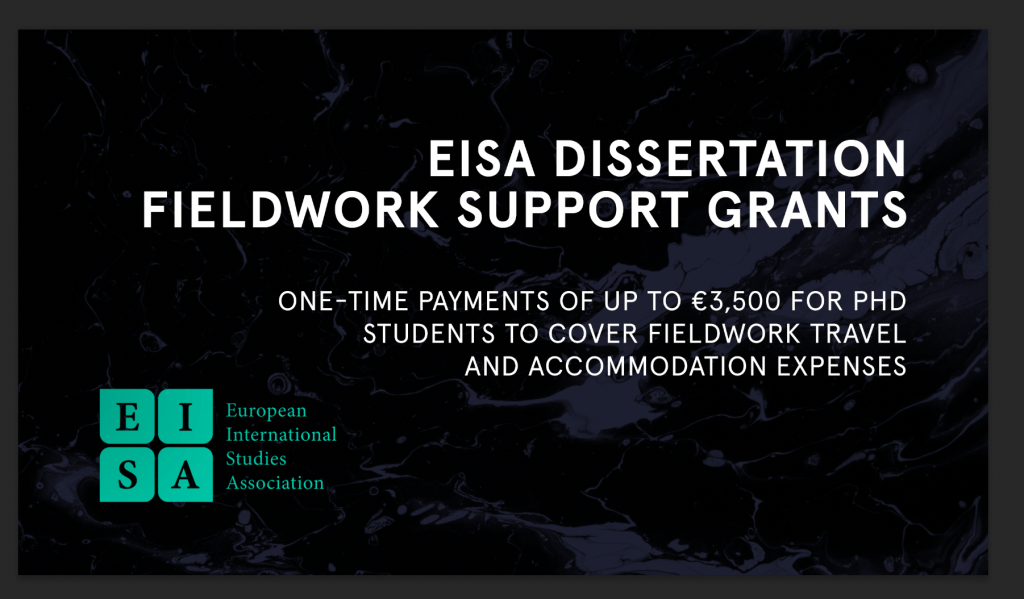
We are pleased to announce the winners of the EISA Dissertation Fieldwork Support Grants
- Franca Kappes
- Judith Hoppermann
- Dhouha Djerbi
- Matias Lennart Castrén
- Aurore Iradukunda
- Madita Standke-Erdmann
- Carolina Zaccato
Many PhD candidates writing their dissertations in International Studies use fieldwork data. However, due to various reasons (scholarship type, institutional budgetary cuts), they lack the finances for fieldwork travel. EISA Dissertation Fieldwork Support Grant aims to support this crucial part of PhD research through the provision of a one-time payment aimed at covering travel and accommodation expenses.
25% of EISA members and PEC/EWIS attendees are PhD candidates. Apart from the Mobility Fund and Early Career Workshops at PEC, the EISA has also supported their academic work after the PhD through the Postdoctoral Bridge Grants in the last year. This new grant scheme supporting dissertation fieldwork will add to our existing funding schemes to support early career researchers, especially those who face different forms of precarity and structural inequality and discrimination.
The recipients will utilise the EISA funding to work on the following fieldwork projects:
Franca Kappes
Geneva Graduate Institute
Franca Kappes is a PhD candidate at the International Relations department at the Geneva Graduate Institute and a 2024/25 visiting scholar at the Center for Puerto Rican Studies at Hunter College, CUNY in New York. Her dissertation, provisionally titled ‘Cyber-Hobos, Nomadic Statecraft, and Diasporic Rhizomes: Tracing the Emergent Topologies of Kinopolitical Liminality in post-Disaster Puerto Rico (2017-2023),’ (I) contrasts the post-hurricane movement trajectories of hypermobile kinetic elites with the recurrent displacement of the Puerto Rican population and diaspora between 2017 and 2023, and (II) theorises their ambiguous relationship with the ‘Anthropocene State’ in an era of disaster acceleration. The EISA Dissertation Fieldwork Support Grant will support four weeks of fieldwork in San Juan, Puerto Rico, in January 2025, during which she will conduct additional archival research and a series of qualitative interviews with a particular focus on the embodied dimension of motion to complement her multi-modal digital repository of kinetic and kinesthetic movement accounts. Her broader academic interests lie at the intersection between International Political Sociology, Critical Security, Disaster, and Mobility Studies.
Judith Hoppermann
University of Glasgow
Addressing the Syrian Crisis: Diplomacy, Governance and Cooperation in Response to Forced Migration in the Levant
Judith’s research project focuses on one of the largest forced migration movements in recent history: Since 2011, the Syrian civil war has led to the displacement of over 6.8 million people, with neighbouring countries hosting the highest number of refugees per capita worldwide.
Her project explores how various actors, including host governments and international organizations, respond to the crisis, examining the extent of their cooperation and its implications for forced migrants in neighbouring refugee-hosting countries. To gather data, fieldwork will be conducted in Jordan, Egypt, and Geneva, utilizing semi-structured elite interviews.
The research aims to fill a critical gap by highlighting the cooperation between state and non-state actors on forced migration. It provides valuable insights for understanding other prolonged refugee situations across different times and regions.
Dhouha Djerbi
Geneva Graduate Institute
Dhouha Djerbi is a PhD candidate in the International Relations/Political Science department at the Geneva Graduate Institute. Her dissertation examines how gendered labor regimes shape social contention within the context of agrarian transformations and peasant movements in post-uprising Tunisia. Blending insights from social reproduction theories with contentious politics, she explores how the mechanisms of gendered labor create gender-bifurcated trajectories of claim-making. As a novice farm worker, her research methodology is rooted in ethnographic principles, involving hands-on experiences working on various farms and in farming households across different regions of Tunisia. In addition to participant observation, her fieldwork, which is slated for completion in late 2025, will collect testimonies from peasants, petty producers, small-scale farmers, rural activists, and other actors who comprise the Tunisian rural contentious landscape.
Matias Lennart Castrén
Heidelberg University
I am writing a dissertation about the Political Economy of India’s Strategic Culture. In my research, I am developing a theoretical framework that conceptualizes the problem of structure and agency against the backdrop of global economic hierarchies. In my study, I posit India within that framework and analyse how India approaches the imperatives posed by the global structures. I am conducting fieldwork in New Delhi to collect interview data for my two case studies: one considering the EU-India trade negotiations and the second focusing on the process of terminating India’s Bilateral Investment Treaties. The upcoming field trip will be the second leg of the complete fieldwork for my thesis. The first trip focused on collecting preliminary data and establishing networks to better organize the field research. The second part of my field research will take a deeper dive into the designed case studies, allowing me to establish the causal story around the main argument of my research.
Aurore Iradukunda
SOAS University London
My doctoral research looks at anticolonial and African student life-words in Portugal between 1945 to 1965. It explores everyday practices of pan-African and anti-colonial consciousness-building in the metropole and their afterlives in the liberation struggles across Lusophone Africa and beyond. The fieldwork for this research combines archival research and life histories interviews which will be conducted across three main sites: Lisbon, Portugal, Praia, Cabo Verde and Bissau, Guinea-Bissau.
Madita Standke-Erdmann
Department of War Studies, King’s College London
Madita researches how legacies of empire continued to shape everyday German foreign policy in India in the 20th century after Independence in 1947 until the onset of market liberalization in the 1990s. The project is curious about how German and Indian women navigated the gendered and racialized dimensions and hierarchies of German cultural and economic foreign policy presence in postcolonial Delhi. Refracted through the prism of the everyday, it traces women’s roles and respective intersecting class, race, caste, and gender relations in three selected institutions – the German Embassy School, Goethe Institute and Siemens AG. Sharing ties and being present in India for up to 150 years, this PhD understands them as both informal yet central realms of foreign policy and sites of social reproduction. By understanding women of multiple backgrounds as imperative to the everyday workings of these centers of power, the work engages their various perspectives, experiences and relations with one another to analyze how intersecting power relations may have upheld or disrupted legacies of empire. It can thus give insight into how male-dominated 20th-century cultural and economic foreign policy intersected with dynamics of globalization and networks and novel formations of (past) empire. The project draws on autoethnography, archival material and photo-elicitation interviews with women formerly employed with these institutions in India and Germany. The EISA’s Dissertation Fieldwork Support Grant will allow Madita to travel to Delhi to visit the selected sites and to expand on and establish in-person contacts with potential interlocutors.
Carolina Zaccato
University of St Andrews
My fieldwork is comprised of two components: archival research and interviews with core regional stakeholders. Thus, I applied for the EISA dissertation fieldwork grant in order to travel to South America and be able to interview diplomats and policy advisers. In particular, my aim is to travel to Buenos Aires, where I already have a well-established network of regional contacts thanks to my active participation in think tanks and professional networks such as CRIES and CARI. From Buenos Aires, I would also like to take two short trips, one to Brasilia and interview diplomats from Itamaraty, and another one to Montevideo, to converse with MERCOSUR officials, to appraise more contemporary understandings and embodiments of the South American regional order and its core principles. Regarding archives, I would like to consult the Historical Diplomatic Archive from the Argentine Minister of Foreign Affairs, which houses a prolific collection on the Pan-American Conferences, so as to analyse regional discourses and norms regarding sovereignty, non-intervention, and anti-hegemonism during the late nineteenth century and early twentieth century.