We are pleased to announce the winners of the EISA Postdoctoral Bridge Grant scheme:
-
- Khaled Alosaimi
- Paulo Victor Zaneratto Bittencourt
- Silvia Carenzi
- Merve Erdilmen
- Yuliia Khyzhniak
- Reda Mahajar
- Maro Pantazidou
EISA Postdoctoral Bridge Grants support recently graduated or final-year PhD students who have not secured an academic contract or fellowship. They are designed to help bridge the gap between a doctorate and a postdoctoral funded/salaried position.
The recipients will utilise the EISA funding to work on the following objectives:
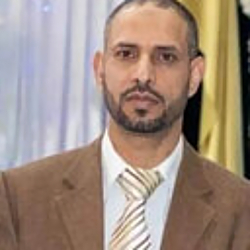
Khaled Alosaimi
Title: How can community-driven reconstruction in post-conflict and peace-transitioning societies address sources of division? A Ground Theory Case study of reconstruction projects and activities in Yemen
Project Overview:
Recent literature highlights the role of community participation in reconstruction for sustainable peacebuilding, yet studies show limited integration of community empowerment into theoretical frameworks. This study examines community-driven reconstruction (CDR) in Aden and Marib, Yemen, during liminal periods before stable peace. Using a grounded theory (GT) approach, this study analyses data from 40 semi-structured interviews across two post-conflict contexts, rural and urban communities- to address the research question: How are local communities empowered to drive reconstruction in post-conflict settings? Four conceptual categories emerged: indigenous knowledge, local governance, social acceptance and aligning personal and community interests as key drivers of empowerment. This model offers a framework for understanding how community-led physical reconstruction fosters social cohesion and sustainable recovery in post-conflict settings, offering strategies for empowerment in similar contexts.
Project Objectives:
-
- I will prepare a journal article focused on governance, shared identity, inclusion, and collective action in community-led reconstruction, targeting journals like Journal of Peacebuilding & Development.
- This project will address gaps in the literature on community empowerment in fragile states like Yemen, emphasizing how communities with limited resources organize and rebuild effectively.
- Bridge Grant will support me in attending international conferences, and joining collaborative working groups on themes around post-conflict community participation and reconstruction
Support from the EISA Postdoctoral Bridge Grant will facilitate this critical work, bridging the gap between my doctoral project completion and future postdoctoral research. The funding will enable access to additional research resources, allow for consultations with academic mentors, and support the costs associated with preparing the manuscript for high-impact publication.
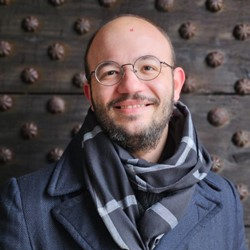
Paulo Victor Zaneratto Bittencourt
Project title: “The crisis of unipolarity across regions: studies on the reconfiguration of the balance of power”
My current project focuses on internationally salient states, examining whether their behaviour can be described in a balance-of-power fashion. Drawing on recent developments in the structural theory of international politics, the goal of my research is to analyse the behaviour of China, Russia, and the United States during international crises episodes, such as the civil war in Syria, the invasion of Ukraine, and the negotiations with North Korea on nuclear issues. It places a strong emphasis on material power, but also on the limits of states’ behaviour depending on their internal capacity building. Importantly, capacity does not mean solely military capacities, but also economic and political ones. Theoretically, the project derives from the Waltzian systemic theory, emphasising not the structural material factors, but rather the interaction between these factors and states. It is intended to avoid proliferating variables so that the theory remains a simple mental construct. Methodologically, in brief, the proposed investigation examines how material capacities and state interactions produce the outcomes observed in the cases. In terms of empirical sources, the project relies on documents issued by the authoritative agencies of the respective governments, allowing for a better understanding of the meaning attributed to their actions. The intended outcome of this project includes four papers that address the different proposed cases and explore distinct theoretical implications.

Silvia Carenzi
Book Project: Explaining the Trajectories of Anti-Assad Islamic Militancy in Syria (2011-2024)
The project builds upon and expands my PhD research by collecting additional original data and sharpening its theoretical framework, with a view to publishing an academic monograph and presenting the findings at international conferences. My research seeks to explain the trajectories of anti-Assad Islamic militancy in Syria, with a focus on Salafi armed groups and their adoption of more locally or internationally oriented approaches. How can the divergent trajectories of these actors be better understood? More specifically, how can their shifting approaches be grasped?
To address these questions, my study combines research on conflict and political violence, social movement studies, and area studies — adopting a relational, dynamic, and processual approach. I employ a comparative case study design, analyzing the trajectories of different Salafi armed groups operating in Syria between 2010 and 2024. Methodologically, the project relies on a triangulation of qualitative methods: field research in Jordan, Turkey, and Syria; online and face-to-face interviews; document analysis of hundreds of primary sources; and digital ethnography.
My study aims to contribute to scholarship in several respects. Theoretically, it fosters cross-fertilization between different fields of research, and from a social movement perspective, it advances the ‘processual’ research agenda. It also offers a novel contribution to scholarship on the diversity of Islamically inspired mobilization and militancy, proposing a more nuanced model. Empirically, it enriches our understanding of the selected case studies by providing a more fine-grained and context-sensitive account — challenging simplistic and security-centered interpretations. Finally, the findings will hopefully bear relevance beyond the case studies at hand and beyond the Middle East region.
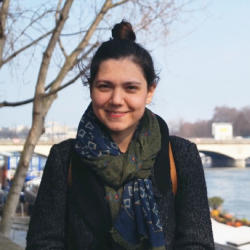
Merve Erdilmen
I am very grateful to the EISA for supporting my on-going research on refugee-led organizations (RLOs)’ practices of gender equality in Turkey. The number of women and queer persons forced to flee violence and persecution is at a record high. While displaced people have long been at the forefront of tackling gender-driven marginalization, much of the International Relations (IR) scholarship focuses on the activities of mostly Western ‘saviors’ who have been traditionally framed as experts. My research investigates how forced migrants who are on the receiving end of humanitarianism approach and influence global gender policies. My PhD dissertation, Refugees as Global Governance Practitioners: The Politics of Gender Equality in Refugee Communities in Turkey, seeks to understand how refugees’ everyday practices and experiences shape gender equality efforts in Turkey. I ask: How do refugee-led organizations approach and practice gender equality? Who are “competent” practitioners in the refugee regime and how does gender inform the notions of competency? I argue that RLOs are competent actors in migration governance with unique characteristics. However, their operational methods, diversity, and the varying levels of recognition they receive from international organizations (IOs) and non-governmental organizations (NGOs), along with differing responses from their communities, illustrate how perceptions of their competence by different groups influence humanitarian hierarchies. For my postdoctoral project, I aim to expand my PhD dissertation’s focus on global governance of gender for refugees by exploring the approaches of Gulf donors to refugee empowerment, as well as the perspectives of refugee women on the impact of Gulf-funded projects on their lives and future goals in Turkey and Lebanon. The EISA Postdoctoral Bridge Grant will allow me to dedicate my efforts to applications and to attend academic conferences.

Yuliia Khyzhniak
I am immensely happy and honoured to have received the EISA Postdoctoral Bridge Grant which will support me in pursuing two projects of mine. The first one is to prepare a funding proposal for the Rubicon grant of the Dutch Research Council. My grant proposal will be dedicated to climate change litigation in international human rights law from the perspective of genre theory. I employ the category of genre to hypothesise that conventional intonations, themes, characters of international human rights law texts are undergoing a transformation due to the need of addressing climate change. It is clear that the thematic and rhetorical appeal of climate change as ‘an unprecedented challenge of civilizational proportions’ does not fit into typical genre characteristics of international human rights law initially tailored to retrospectively address concrete violations through employing dramatisation of suffering, invoking empathy and celebrating triumphant progress towards the ideal of human rights. International human rights law has to overstretch its design and purpose in order to handle the challenge of climate change which leads, in a sense, to a crisis of genre. The second project of mine is to finalise a book proposal based on my doctoral dissertation. In it, I use narrative theory to analyse how the European Court of Human Rights changes its jurisprudence and argue that previous judgments constitute a narrative problem for the Court. I show that the ECtHR alters its approach to a certain legal issue through constructing and developing a human-like character of the Court in its judgments. Such a character allows the ECtHR to make departures from previous positions smoother and to avoid a conflict with predecessors.
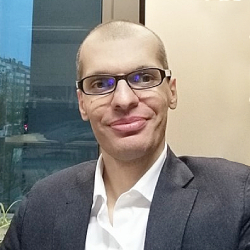
Reda Mahajar
As a refugee researcher who faces systemic institutional barriers to advancing my postdoctoral research, I consider the EISA Postdoctoral Bridge Grant to be a wonderful opportunity both to focus on my book project and to participate in conferences relevant to it. I am deeply grateful to the EISA Governing Board for granting me this opportunity.
My book proposal, based on my PhD thesis, will addresse the ‘Sunni’/‘Shia’ divide, which is reproduced and recirculated throughout the spaces and histories of the ‘Arab and Muslim worlds’. Yet the social actors labelled ‘Sunnis’ or ‘Shias’ are heterogeneous, each with its own internal antagonisms. For example, secular pan-Arab Sunnism is antagonistic to the Sunnism of Islamist terrorist groups such as ISIS. Furthermore, the labels ‘Sunni’ and ‘Shia’ are not distinct but are defined in relation to each other. Given these internal divisions and mutually constitutive relations, the significance and apparent solidity of the designations ‘Sunni’ and ‘Shia’ in contemporary politics are puzzling. What sustains the enduring unity of these designations, given the diversity of political, cultural and economic contexts inhabited by populations labelled ‘Shia’ or ‘Sunni’?
The existing literature within Middle Eastern and Islamic studies often examines these designations through a reductive spectrum of instrumentalism and primordialism rooted in colonial epistemology. Viewed through the lenses of post-structuralism and post-colonial theory, the book proposal will critically examine the historical stubbornness of Sunni and Shia designations as categories of power in various Arab and Muslim spaces, as well as in the proverbial ‘West’. It will do so by decentring Sunni and Shia social actors and redirecting the research gaze towards the roles of gender, sexuality, power, culture and representation in the reproduction of these categories.
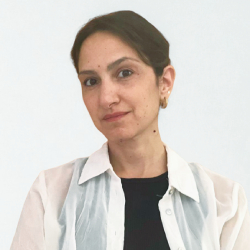
Maro Pantazidou
My doctoral project titled ‘Precarity and the Politics of Time: Doing Care, Rethinking Work’ aspires to imaginatively approach the crises of labour and care which underpin European politics. The research foregrounds a multi-disciplinary politics of time which I argue can provide analytical tools, political orientation and practical proposals for the redistribution of care activities, the reconfiguration of notions of work, and the development of more caring, viable, and fair ways of living. The research explores the theoretical and practical possibilities of approaching time as a collective resource in the context of widespread inequality and precarity. Situated within fractured welfare landscapes and fragmented work-time regimes in the Global North, the project unfolds along two streams: a) the first unearths, through participatory research with citizen initiatives, the practices, patterns and orientations towards time which form and sustain urban informal care infrastructures; b) the second uses in-depth qualitative analysis with precarious care workers to shed light on how the experience of multiple time-senses within fragmented care economies develop new subjectivities and future visions of (care) work. Put together, the two streams empirically ground precarity as a temporal experience, advance the study of time as an issue of justice, and articulate a conceptual horizon of ‘time as a commons’ in support of the just redistribution of labour, care and vulnerability in a broken world. This horizon is geographically expansive though my fieldwork – situated in Athens, Greece – delivers a rich picture from a peripheral economy in-between North and South and constantly in-between crisis and recovery. The research is anchored in the political economy of precarity and of the care crisis, in feminist theory on care ethics and in post-growth critiques within IR. The EISA grant will enable me to complete two papers on the two streams outlined above and submit them to high-ranking journals. It will also support me to develop a community-oriented output on the topics (podcast and exhibition).