

- This event has passed.
Solidarity Across Uneven Terrains: Practising Care and Resistance within Neoliberal Academia
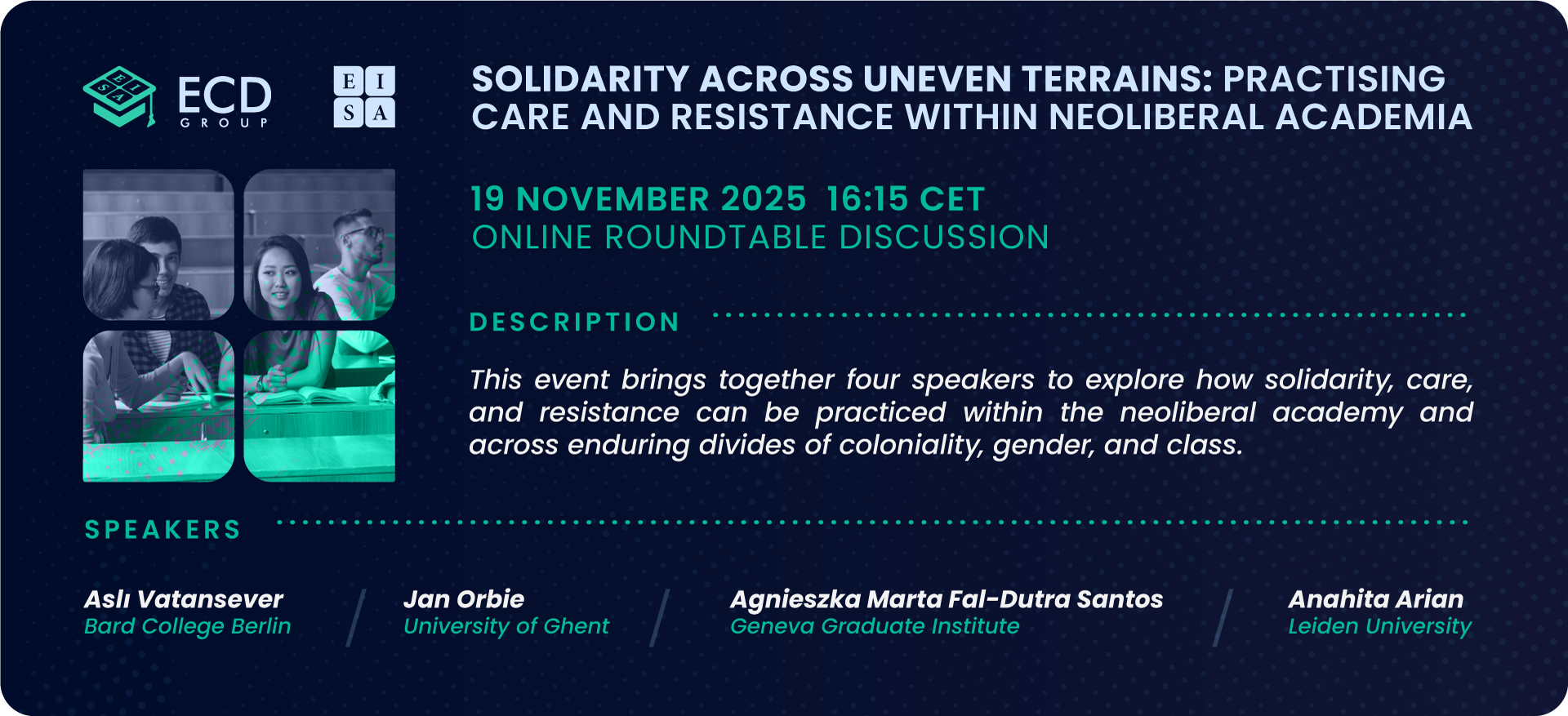
ZOOM EVENT: WEDNESDAY, 19 NOVEMBER 2025, 16:15 – 17:45 CET
Early career scholars around the world are facing a shifting academic landscape marked by relentless budget cuts and series of short-term contracts that barely allow for a predictable, let alone dignified, life; the encroachment of governments on academic freedom, the tightening grip of surveillance metrics and publication quotas (Wilsdon 2015); and the unprecedented changes brought about by the emergence of generative AI, which has unsettlinging the very foundations of academic integrity, research ethics, and trust in scholarly labour itself. Yet the terrains from which we navigate these challenges are far from even: women academics continue to disproportionately carry the invisible burdens of teaching and care, with measurable drops in research output compared to their male peers during the Covid-19 pandemic (Sinnner et al. 2021) and racialized scholars remain systemically underrepresented in ‘Western’ academia (Zvogbo et al. 2023, Beutel and Nelson 2006). Globally, academia continues to be shaped by the postcolonial ‘Global South – North’ divide (Mbembe 2016), resulting in a dominance of Eurocentric epistemologies in the Social Science (Spivak 1988) and uneven access to publication and funding. While the introduction of ‘diversity’ metrics by European and North American academic institutions may indicate positive change, extractivist practices of scholars located in institutions of the ‘center’ persist and the reluctance to confront the deeper architecture of structural racism endures (Ahmed 2012). Meanwhile, the estrangement between the neoliberal academy’s ivory towers and the life worlds of those we study has only deepened over the past decade—despite efforts to widen access for students from working-class backgrounds and to reinvent ourselves as ‘citizen scholars’ (Boyte 2008) and ‘scholar activists’ (Herring 2006). In this online event we invite the wider EISA community to join us for a reflection on the current status quo of the neoliberal academia and explore existing forms of solidarity, care and resistance, and the potential for change. We explore how and whether our practices can contribute to making academia more just – structurally and in the everyday, paying specific attention to three of the most entrenched lines of academic stratification—those of coloniality, gender, and class.
Guiding Questions:
- How do colonial legacies, gendered divisions of labour, and class inequalities intersect to shape the conditions of scholarly life under neoliberal academia?
- What forms of solidarity, care, and resistance are scholars already enacting and what can we learn from them, especially as early-career scholars in International Relations?
- Given the depth of these systemic inequities and the current state of the world, can the neoliberal university be reformed from within, or must it be abolished?
Speakers
- Aslı Vatansever, Bard College Berlin
- Jan Orbie, University of Ghent
- Agnieszka Marta Fal-Dutra Santos, Geneva Graduate Institute
- Anahita Arian, Leiden University
Chairs
- Franca Kappes, Geneva Graduate Institute
- Leonie Felicitas Jegen, University of Amsterdam
Bibliography
Ahmed, S. (2012). On being included: Racism and diversity in institutional life. Duke University Press.
Beutel, A.M. and Nelson, D.J., 2006. The gender and race-ethnicity of faculty in top social science research departments. The Social Science Journal, 43(1), pp.111-125.
Boyte, H. (2008). The citizen solution: How you can make a difference. Minnesota Historical Society Press.
Herring, E. (2006). Remaking the mainstream: the case for activist IR scholarship. Millennium, 35(1), 105-118.
Skinner, M., Betancourt, N., & Wolff-Eisenberg, C. (2021). The disproportionate impact of the pandemic on women and caregivers in academia. ITHAKA S+ R.
Spivak, G.C., 2023. Can the subaltern speak?. In Imperialism (pp. 171-219). Routledge.
Mbembe, A. (2016). Decolonizing the university: New directions. Arts and Humanities in Higher Education, 15(1), 29-45. https://doi.org/10.1177/1474022215618513 (Original work published 2016)
Wilsdon, J. (2015). The metric tide: Independent review of the role of metrics in research assessment and management. https://www.ukri.org/publications/review-of-metrics-in-research-assessment-and-management/ [retrieved 22/09/2025].
Zvobgo, K., Sotomayor, A.C., Rublee, M.R., Loken, M., Karavas, G. and Duncombe, C., 2023. Race and racial exclusion in security studies: A survey of scholars. Security Studies, 32(4-5), pp.593-621.