We are pleased to announce the winners of the EISA Dissertation Fieldwork Support Grants
-
- Matthew Broomfield
- Esteban Octavio Scuzarello
- Aaron Magunna
- Lena Kempermann
- Thais Simoes Doria
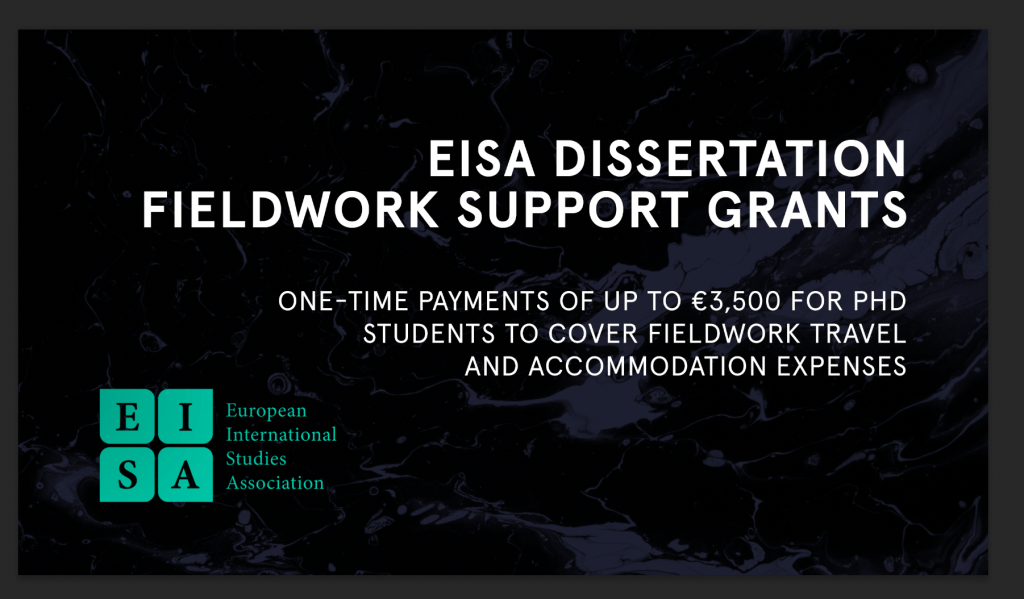
Many PhD candidates writing their dissertations in International Studies use fieldwork data. However, due to various reasons (scholarship type, institutional budgetary cuts), they lack the finances for fieldwork travel. EISA Dissertation Fieldwork Support Grant aims to support this crucial part of PhD research through the provision of a one-time payment aimed at covering travel and accommodation expenses.
25% of EISA members and PEC/EWIS attendees are PhD candidates. Apart from the Mobility Fund and Early Career Workshops at PEC, the EISA has also supported their academic work after the PhD through the Postdoctoral Bridge Grants in the last year. This grant scheme supporting dissertation fieldwork will add to our existing funding schemes to support early career researchers, especially those who face different forms of precarity and structural inequality and discrimination.
The recipients will utilise the EISA funding to work on the following fieldwork projects:
Matt Broomfield
University of Sussex
@mattbroomfield1
I am a doctoral researcher studying sovereignty, governance and hegemony amid evolving conditions of conflict and globalization in the contemporary Middle East, through the unique case study of Kurdish-led North and East Syria (NES).
Amid regional dynamics of neoliberal globalization backed by authoritarian states and Islamist armed groups, NES’ so-called ‘Rojava Revolution’ claims to model a direct-democratic, decentralized alternative. Far from being an exceptional outlier, NES’ claimed anti-statist, counter-hegemonic project is located at a key nexus of contemporary conflict and evolving conditions of sovereignty—a fact underscored by dramatic, ongoing geopolitical developments in Syria. My research will explore real-world, day-to-day practices of governance and the production of political subjectivity in NES, asking how these processes are embedded in broader contexts of civil war, state conflict and globalization.
I previously lived and worked in NES for three years as a journalist, Kurdish speaker, and co-founder of the region’s top independent news and research center. For my fieldwork, I will return to NES to conduct a site-based political ethnography, alongside a novel diary process working with students at Rojava University, Qamishlo.
My PhD (International Relations, University of Sussex) is ESRC funded, and supervised by Dr. Kamran Matin and Dr. Louiza Odysseos.
Esteban Octavio Scuzarello
European University Institute
@estebanscu
Performing asylum: a study on refugee status determination processes in Brazil and Mexico
This research explores how identity influences asylum decisions beyond official procedures and legal definitions. While asylum seekers are expected to prove the credibility of their fears and their identity, I argue that identity shapes outcomes in deeper, less visible ways. My fieldwork in Tapachula (Mexico) and Sao Paulo (Brazil) will involve interviews and observations with asylum seekers, government officials, and NGO workers to understand how identity is performed, interpreted, and negotiated throughout the asylum process. By focusing on everyday interactions and informal spaces, this project seeks to uncover how refugee status is influenced not only by law, but also by social expectations, institutional practices, and collective dynamics related to identity.
Aaron Magunna
University of Queensland
@aaronmagunna
My research examines Japanese infrastructure development financing in Southeast Asia and semiconductor-related industrial policy in the context of the ‘Second Cold War’ between China and the United States. I am specifically interested in economic ‘statecraft’ and how the ability of state institutions to exercise statecraft is conditioned (and often constrained) by domestic political economy dynamics, most notably the limited capacity of state institutions to compel private capital to invest in projects that are insufficiently bankable from a private sector perspective.
To further develop this research, I will be travelling to Japan to speak to experts, policymakers, and private sector representatives. This fieldwork will help to further triangulate my research findings up until this point. I am very grateful for the EISA’s support for this project.
Lena Kempermann
Lund University
@LKemperm
My PhD project examines how women’s roles and strategies influence peace agreement outcomes and how persistent gendered power dynamics undermine their equitable and meaningful representation in these settings. It highlights the critical need to address the patriarchal structures embedded in peace negotiations, which remain heavily militarized and masculinized spaces. By exploring how women navigate, challenge, and adapt to these dynamics, this research seeks to advance peace and conflict studies and international negotiation research by uncovering the barriers to achieving equal representation and effective outcomes. To do this, I apply a mixed methods approach which combines a global dataset on disaggregated female participation in peace negotiations with a comparative study of two major peace processes: Northern Ireland and the Minsk Agreements in Ukraine before 2022. This comparison explores how women’s strategies vary across roles and how power imbalances impact participants differently. For both cases, I conduct interviews with participants, staff, and activists, alongside archival and media analysis, to understand the dynamics of negotiations and how power structures shape women’s agency.
Thaís Simões Dória
University of Warwick
@doriathais
Thaís Simoes Doria’s PhD research investigates questions of positionality and agency in International Relations by examining the foreign policy discourses of intermediate states in the Global South—specifically Brazil, South Africa, and Indonesia. With support from the EISA Dissertation Fieldwork Grant, she will carry out fieldwork in South Africa (Pretoria, Johannesburg, and Cape Town), conducting interviews with policymakers, diplomats, journalists, and scholars. She will also engage with institutions such as the Department of International Relations and Cooperation (DIRCO) and the South African Institute of International Affairs (SAIIA). This fieldwork will generate first-hand empirical data and strengthen the comparative and theoretical contributions of her research.